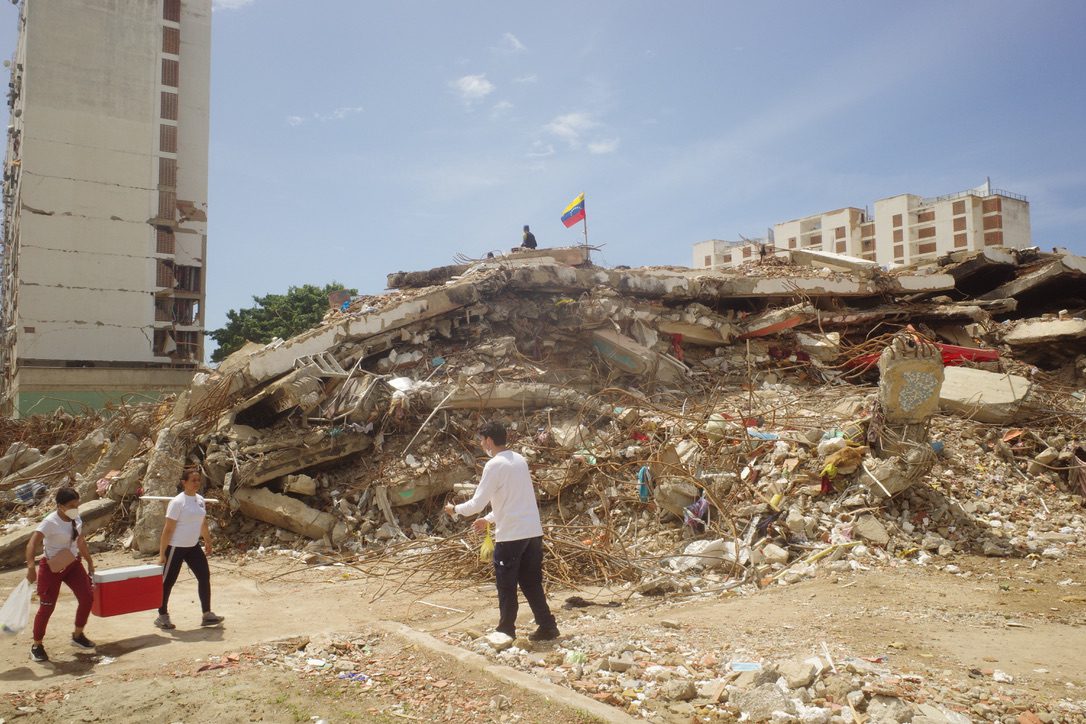
On the road, through the bus window, the destruction is already visible, worse than on television. The stifling heat and dusty air catch in your throat as soon as you step off, while police and soldiers patrol the whole area. In Caribe (La Guaira), three months after the double earthquake of 24 June, which killed more than 6,500 people, the landscape is still in ruins.
A state that is present, but not where you would expect it
Thousands of people are still living outdoors, in temporary shelters. “We have a lot of trouble breathing. Because of the dust, many of us have pain in our lungs and throat,” says a resident from his tent. He is indignant: “Most people here are poor. Those with money had the buildings that held up best, and most of them have already left.”
The vast majority of rescuers searching for bodies under the collapsed buildings are not civil servants or even officially deployed professionals, but local volunteers, people from other cities or from abroad. “I’ve been a volunteer rescuer since the second day. This morning, for example, we managed to pull out five bodies,” says José proudly, wearing a white suit, a respirator and a protective hood. Yet José and his colleagues are struggling. “Without help, we won’t last much longer,” he warns.
The residents we spoke to point to the state’s slow and inadequate response, even though it is omnipresent through its police and military posts. Faced with the emergency, the authoritarian state seems at a loss, but keeps up its habits of social surveillance. In recent months, several aid workers have complained about restrictions imposed by the security forces, measures the population found hard to accept amid the emergency.
Solidarity running out of steam
On the boot of a white car, parked near a charity’s food stall, big letters read: “The people of La Guaira are not a burden, they are my brothers.” The number plate is not local. Like this slogan, the wave of solidarity that followed the disaster was spontaneous, massive and nationwide. It helped those affected survive and keep hope alive.
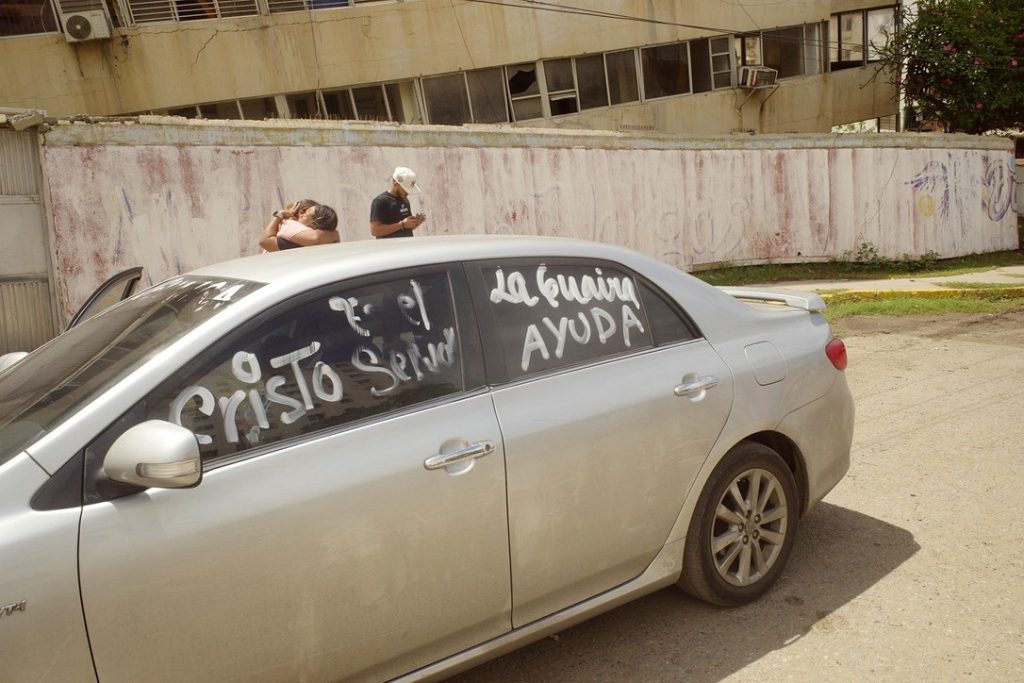
But in recent weeks, solidarity has been running out of steam. The organisations on the ground and the informal groups of volunteers are increasingly short of equipment, volunteers and specialist professionals. “The number of volunteer doctors has dropped a lot,” Yonatan regrets. He is himself a volunteer doctor with Cadena de Favores in Playa Grande. Still, he understands why: “People are going back to their lives, to their daily struggle.”
In a rescuers’ WhatsApp group, the list of needs keeps growing: “torches, rotary hammers, basic supplies, toothpaste, soap, clothes, etc.” Scrolling through the conversation, you can see the scale of the logistical challenge: getting supplies to the right place, and making sure some sites don’t end up with too much while others have too little. With so many emergencies competing with one another, volunteers are often left to make the difficult choices.
Oleydis, a medical student in Valencia, comes to help in La Guaira whenever she has time. Since she first came, she has seen the situation clearly worsen: “People are doing worse and worse psychologically, worse than in the first days,” she says sadly. Many groups focus on this, such as the Payaso con Bata foundation, which regularly travels from Valencia to offer the people of La Guaira affection and free hugs.
In the midst of a democratic transition?
Unsurprisingly, the International Rescue Committee found that “the Venezuelan state’s response did not match the severity of humanitarian needs”. Yet the spectacular US intervention in January had raised high hopes, which were revived after the earthquake by Secretary of State Marco Rubio: “The aid will be substantial, fast and effective.”
Three months on, the new guardianship is showing its limits. The disillusionment is hard to put into words. “At first, we Venezuelans thought there was a strategy behind all this,” admits Hiowanka Ávila, a forty-year-old caraqueña, a native of Caracas. In January, she dreamt of change. Today it hurts her to see US generals on television, cosying up to Diosdado Cabello and the Rodríguez siblings.
Hiowanka’s brother, Henryberth Rivas, is one of the country’s 400 political prisoners. Held for eight years, he was charged with attempting to assassinate Nicolás Maduro while taking part in peaceful protests. For several years, Hiowanka has been denouncing her brother’s arbitrary detention, the torture and degrading treatment he has suffered, and the fact that he is still being held despite his deteriorating health.
Hiowanka now spends her nights in a camp opposite Rodeo 1, the prison where her brother is held, an hour from Caracas. The last time she went to the prison administration to demand the release of her sick brother, the officials on duty that day told her: “Because of the tragedy, we are only working half-time. Don’t be selfish, the whole Venezuelan state is focused on helping the people of La Guaira.”
Did you find this article interesting?
Veines Latines is funded by its readers. No advertising, no shareholders: your support lets us report from all over Latin America with complete independence.