This article was first published on August 4, 2023 by the Fondation Jean-Jaurès.
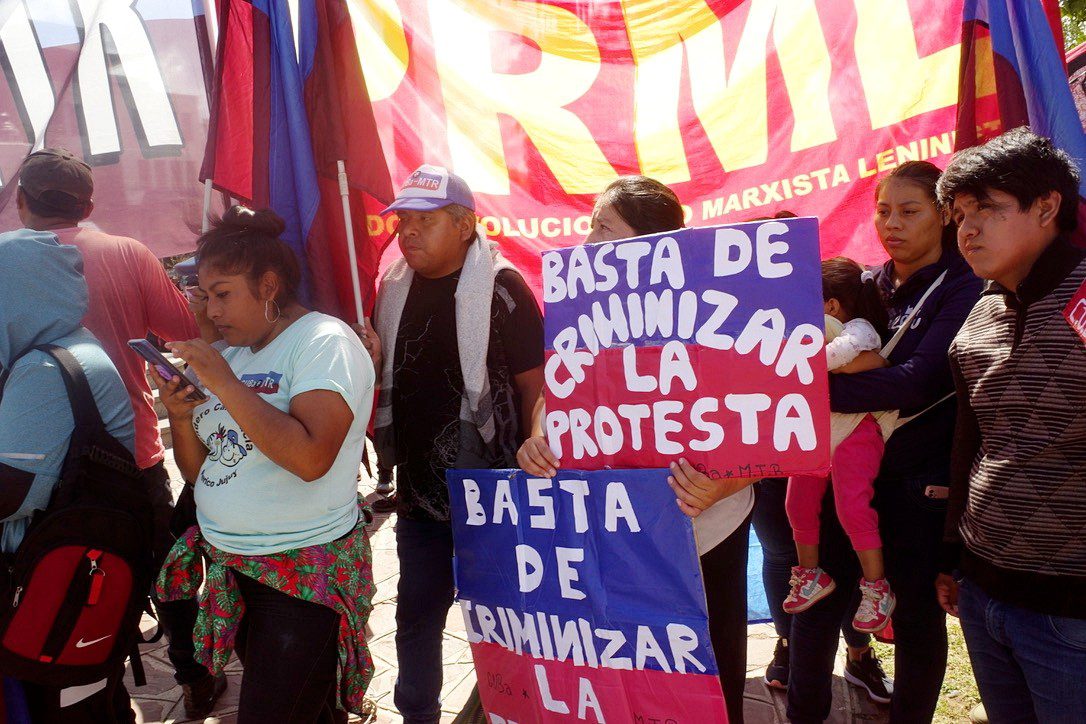
The province of Jujuy, in north-western Argentina, has lived through a historic popular uprising in recent months. Primary and secondary school teachers’ pay demands were joined by strong, widespread opposition to the constitutional reform of the Radical governor Gerardo Morales, notably in the form of road blockades.
The woman who embodied this social struggle in Jujuy for years, Milagro Sala, is Argentina’s most divisive prisoner. On 16 January 2016, she was arrested by the police during a peaceful encampment held by her organisation, Tupac Amaru, beneath the windows of the province’s new governor, one Gerardo Morales. She has never been released since. The country’s human rights organisations, the UN and the inter-American human rights system quickly denounced an “arbitrary detention”, and her supporters continue to condemn a political vendetta. To no avail. Charged in a dozen different cases, Milagro Sala has received two final criminal convictions, the most recent being a Supreme Court ruling last December in the Pibes Villeros case (named after a construction cooperative), concerning the embezzlement of public funds. While her lawyers have taken her case to the Inter-American Commission, domestic remedies having been exhausted, her health keeps deteriorating. We were able to meet her on 1st June in her house arrest in San Salvador de Jujuy.
Can you tell us more about your current state of health?
Milagro Sala: It’s hard. I have very advanced thrombosis with three blood clots. One in my knee, one in my lower leg and another near my groin. I need two operations. Unfortunately, everything gets mixed up with politics here, and the governor of Jujuy has forbidden my transfer to Buenos Aires for surgery. He also threatened three clinics in Jujuy, the Rosario clinic, the Los Lapachos clinic and the San Pedro clinic, which produced falsified reports claiming I am in good health.
However, my lawyers went to Buenos Aires and met the Favaloro Foundation, which says the opposite. According to them, my thrombosis is getting seriously worse and requires two surgical operations. They are also asking the Jujuy clinics to amend their reports.
I’m fighting this battle right now, and I should have been in Buenos Aires more than four months ago. The operations can’t be done in Jujuy because the clinics refuse to treat me. The government threatened not only the doctors but also the clinic owners. They are afraid. All of this is proven: we have recordings of the doctors saying my health is poor. And they are the same people cited in the reports saying I’m fine. Look how swollen my leg is, look at the difference with the other one.
Do you know when you will be released? How do you see what lies ahead?
I have absolutely no idea. I don’t believe I’ll get parole next year. I believe that as long as Gerardo Morales is governor, I won’t be free. But there is something more serious. The priority of the provincial government, and of President Alberto Fernández too, is business, especially lithium, oil and tobacco, and they see my release as a danger to the province’s economic interests.
As for the October elections and what they might change, it all depends on who the new president is. Change won’t come from the judiciary, which today is tied to right-wing political circles. And I say that as much about the Jujuy judiciary as about the national Supreme Court.
The Argentine League for Human Rights counts sixteen political prisoners in the country. What does that make you think?
Mauricio Macri’s term (2015-2019) saw many political prisoners appear. Jujuy was the laboratory. The laboratory of lawfare (judicial harassment of left-wing activists). That’s where they started. And since it worked well here, they carried on elsewhere. In Buenos Aires, then in Brazil with Lula, in Venezuela, and so on. The persecution Commander Maduro has suffered is staggering. It comes from the United States embassy, just like during the military dictatorship. Today the right is a bit more polished, that’s the only difference. They operate by fabricating court cases from scratch and paying witnesses. Not a day goes by without the intelligence services at work here in Jujuy, and they are very well paid for what they do.
They operate by fabricating court cases from scratch and paying witnesses.
How do you explain the Supreme Court’s decision to uphold your conviction, and President Alberto Fernández’s inaction?
Honestly, it’s a farce. The judges say they are upholding the conviction because they cannot interfere with provincial justice, but that’s madness. If a case goes to the Supreme Court, it’s precisely so that the judges examine it in full. Instead, they chose to hide behind a legal article.
Fernández let me down because the judiciary in Argentina is completely beyond his control. Lawfare is too deeply rooted. It began under Mauricio Macri’s term and targets social organisations and trade unions. It goes back a long way, and Fernández has shown he is powerless to overturn the established order.
How do you feel about the hearing before the Inter-American Court of Human Rights?
I will sit in the dock as I should and bring them proof of everything we have achieved. I will bring them proof that the prosecution witnesses were paid and that they are the same people in the different cases. I will bring them proof that yes, I am a political prisoner, that I have been detained for more than seven years and that I have also suffered violence. I am under house arrest, but I keep working and campaigning with Tupac Amaru. I’m not a candidate, but I keep learning and doing politics.
The injustice I found hardest was that they went after my family, especially my husband, my children and my grandchildren. They terrorised them.
How did you experience prison? What injustice has marked you most since your arrest in 2016?
In prison I was persecuted 24 hours a day. Even when I showered, the guards watched me. They put cameras in my cell to spy on my every move. I could never be at peace; they were always behind me. The mistreatment I suffered was staggering.
The injustice I found hardest was that they went after my family, especially my husband, my children and my grandchildren. They terrorised them. Being a political prisoner is one thing, but going after your family is something else. Media outlets that refused to speak ill of me and my family were threatened and lost their funding.
How would you describe the provincial government of Jujuy? As a dictatorship?
Dictatorship is a strong word. But you could say the Jujuy government is an authoritarian government, far too authoritarian. Police repression of social organisations, trade unions and political parties has been violent. It is also a narco-state. Drugs have spread very fast in recent years, and many children, young people and old people have died or disappeared here in Jujuy.
The constitutional reform they are currently preparing is a dictatorial reform. They will be able to expropriate anyone, and in particular to expropriate Indigenous peoples from their lands. This reform gives more power to foreign companies than to the jujeños themselves.
In your view, what are the main political challenges the province currently faces?
We are an extremely resource-rich province: lithium, sugar cane, tobacco and so on. But the money doesn’t stay in Jujuy; it leaves the province and doesn’t benefit the people who live here. Today Jujuy is an indebted province and a poor province. It is one of the poorest provinces in Argentina even though we have enormous resources. If the wealth stayed inside the province, Jujuy would be one of the most developed provinces in Argentina. Unfortunately, today the opposite is happening.
What would you like to say to the people who speak ill of you?
That I haven’t even had the chance to defend myself. That this right is mine. Everyone can judge me, but at least after I have been heard.
I want a people’s trial, a trial in which I can explain myself and produce proof of everything we have built. Like any citizen who has the right to defend themselves. Not in a court that answers to lawfare and the United States embassy, but in a court that answers to the national and popular camp. I want them to give me the opportunity to truly defend myself.
How do you view what is currently happening in the province of Salta1?
The truth is, Salta is following Jujuy’s example. They are passing an antipiquetes law (anti-protest law) so that nobody can protest. In Jujuy we also had an antipiquetes law in the past. Gerardo Morales passed that law in 2016; it was called the misdemeanours law. If they catch you protesting in the street, you get fined and risk being taken to court.
Look at the level of awareness of the teachers in Salta who are fighting for a decent wage. A teacher in Salta earns on average 150,000 pesos a month [around 260 euros]. And they only have that salary because they took to the streets in the past. No demand is ever won without a fight in the street. In Jujuy the situation is worse. A teacher earns between 50,000 and 100,000 pesos [roughly 85 to 170 euros] at the start, and it then rises with seniority.
What message would you like to send to everyone fighting for their rights around the world?
We human beings have the right to defend ourselves. That is also what the word democracy means. You have to read, write and educate yourself. Everyone must educate themselves in order to be able to defend themselves.
Did you find this article interesting?
Veines Latines is funded by its readers. No advertising, no shareholders: your support lets us report from all over Latin America with complete independence.