This article was first published on August 23, 2022 in lundimatin.
It was between four and five in the morning on 15 June, five days before the presidential run-off, when some forty young activists were arrested in their homes in Cali, Bogotá, Medellín and Bucaramanga, for events that took place last year during the paro nacional (national strike). All of them had been on the “front line” of the social movement, protecting demonstrators from attacks by the security forces and by armed civilians. Neither the statements of newly elected president Gustavo Petro, who asked the Attorney General to “free our young people”, nor those of vice-president Francia Márquez, who called for “a review of the trials”, will change anything. The trials that have begun are now bound to the timetable of criminal procedure.
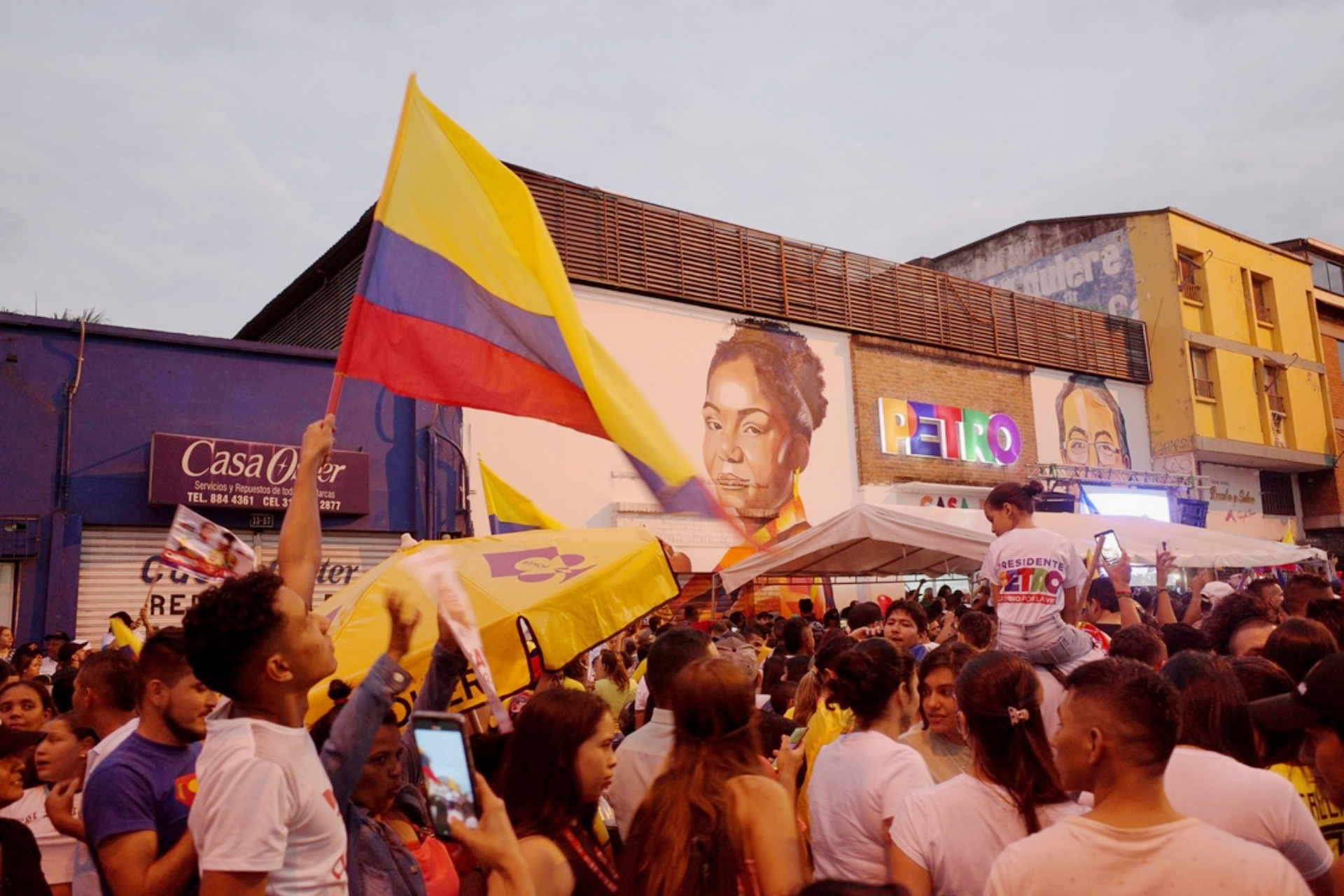
Yet when the left won for the first time in its history, on 19 June, a few minutes before five in the afternoon, Colombia seemed to have broken through a wall in time. Luis Carlos, known in the resistance as Playita after the neighbourhood he comes from, a former spokesperson for the front lines of the Meléndez district in western Cali, felt it in his bones. The police had been hunting him for days, and he knows he would still be wondering where to spend the night if, “by some misfortune”, the other candidate had won. “I was afraid they would set me up in a false positive, but now I feel at ease,” he confides three days after the results. He noticed an “immediate change”, pointing to the thousands of people who gathered from five o’clock onwards at the symbolic site of the Loma de la Cruz, celebrating peacefully all night long, without unrest and without police. That was not something Colombia was used to.
“I was afraid they would set me up in a false positive, but now I feel at ease.”
His joy was short-lived, however. The nine young people seized that day in the Puerto Resistencia neighbourhood of Cali are his comrades in the resistance, and two of them, Jhon and Alejandro, are close friends. Criminal conspiracy, kidnapping and torture of a police officer, two homicides including that of a security guard, arson of a police station and arson of a motorbike: these are the six charges that weigh, in whole or in part, on the young activists. While the Colombian prosecution does not directly incriminate their participation in the social protest, it describes the front line as a “criminal organisation” and its members as criminals who infiltrated the social movement.
“The right hates the front lines because, thanks to us, the country woke up politically,” says Playita. For his friend Juana, spokesperson for the Loma de la Cruz resistance point during the strike, the authorities wanted to intimidate people so they would not vote, but also to provoke them into making a mistake. “Creating chaos a few days before the vote would have given them an excuse to suspend the elections,” she adds. According to Juana, the authorities are now “building a judicial set-up”, in particular by tampering with witnesses: “It’s all orchestrated. They are trying to manipulate some of the comrades they are holding, dangling dropped charges or reduced sentences in front of them so that they testify against the others. Their main witness is called Lazarca; she has mental health problems and they are using that. She fell out with several of us during the strike, and we fear she will testify at trial against some of our friends.”
“The right hates the front lines because, thanks to us, the country woke up politically.”
In Cali, five lawyers took on the case at the outset. Presenting themselves as human rights defenders, proud to represent leaders of the social protest, they charged no fees and worked on the files together, since they were all linked by the common charge of criminal conspiracy. Attentive to the lives of these activists from poor backgrounds, they know that since the end of the strike they have been involved in popular assemblies, political education workshops, social dialogue, notably with the mayor’s office, community gardens and the sale of handicrafts.
According to lawyer Dicter Zuñiga Pardo, who handled one of the files, the prosecution has no serious evidence of the defendants’ guilt, which explains its strategy of tampering with witnesses to back up its allegations. In his view, the offence of criminal conspiracy, on which all the others rest, is very far from being established: “The intercepted radio and phone communications are just exchanges about whether or not the police are around; at no point do they show that an offence was premeditated. It’s only natural that they talk to each other.”
First charged with vandalising public or private property and blocking public roads, then with assaulting police officers and terrorism, and now with criminal conspiracy, young Colombian protesters have been subjected to the shifting legal strategies of the Attorney General
The lawyers, along with a number of human rights organisations, denounce a political trial and a selective justice system that targets young people from poor neighbourhoods. Before these arrests, made between the two rounds of the presidential election, others had taken place on the first anniversary of the paro nacional, on 28 April 2022. Five young people were arrested at the time in the Chimi Resistencia neighbourhood, although in their case they escaped detention. Across the country, 170 demonstrators have been brought before a judge since the strike began. First charged with vandalising public or private property and blocking public roads, then with assaulting police officers and terrorism, and now with criminal conspiracy, young Colombian protesters, subjected to the shifting legal strategies of the Attorney General, have never been able to exercise their right to peaceful assembly in safety.
On 15 June, the security forces turned up at dawn at the defendants’ homes, kicked the doors in and pointed their weapons at children. The young people, presumed innocent, then spent almost a whole month in a police station, as they could not be transferred to a prison because of overcrowding. At one point, the Nuevo Floresta police station held 73 detainees for a capacity of 15. Damp rooms with no windows or ventilation, shared by several people, with hammocks and mattresses on the floor; rotting food (mould could be seen on the detainees’ bread during one of the hearings); no specialised prison staff; no visits allowed: these give an idea of the conditions of detention.
Now much sought after, the young detainees have recently entrusted their defence to well-known Bogotá law firms. These will have their work cut out against an Attorney General who remains in office for the next two years and has no intention of backing down. The defendants are currently held in Jamundí prison, in a rural area an hour from Cali. Although a possible legislative intervention hangs over the trials, the hearings are going ahead on schedule. After the hearings before the judge of guarantees, the next step will come in three months, when the prosecution formally presents its indictment. First-instance rulings are expected within a year at the latest.
Did you find this article interesting?
Veines Latines is funded by its readers. No advertising, no shareholders: your support lets us report from all over Latin America with complete independence.